Choosing between AC and DC distribution panels starts with a practical question: what kind of power does your equipment use? AC panels distribute alternating current, while DC panels distribute direct current. That difference affects compatible protective devices, wiring arrangements, and connected loads. It is not just a label on a cabinet. A panel serving a building’s lighting and outlets may have different requirements from one supplying battery-based equipment or a solar system’s DC circuits.
If you are asking “what is the difference between ac and dc distribution panels,” begin by tracing the power path. Note the source, operating voltage, load types, and any conversion equipment between them. Then consider fault protection, grounding, enclosure conditions, available capacity, and room for future circuits. These details help clarify which panel suits the installation, but a general comparison cannot replace a design review. Small details matter. A converter, for example, may connect AC and DC sections, yet each side still needs suitable components and protection. A tidy diagram can also overlook a maintenance constraint or an unusual load; I would check those assumptions before choosing. Requirements vary by application and equipment, so verify panel ratings and protective-device compatibility with current manufacturer documentation. For complex or high-energy systems, ask a qualified electrical professional to review the design. The right choice is the one that safely matches the power source and loads, not simply the panel that appears more familiar.
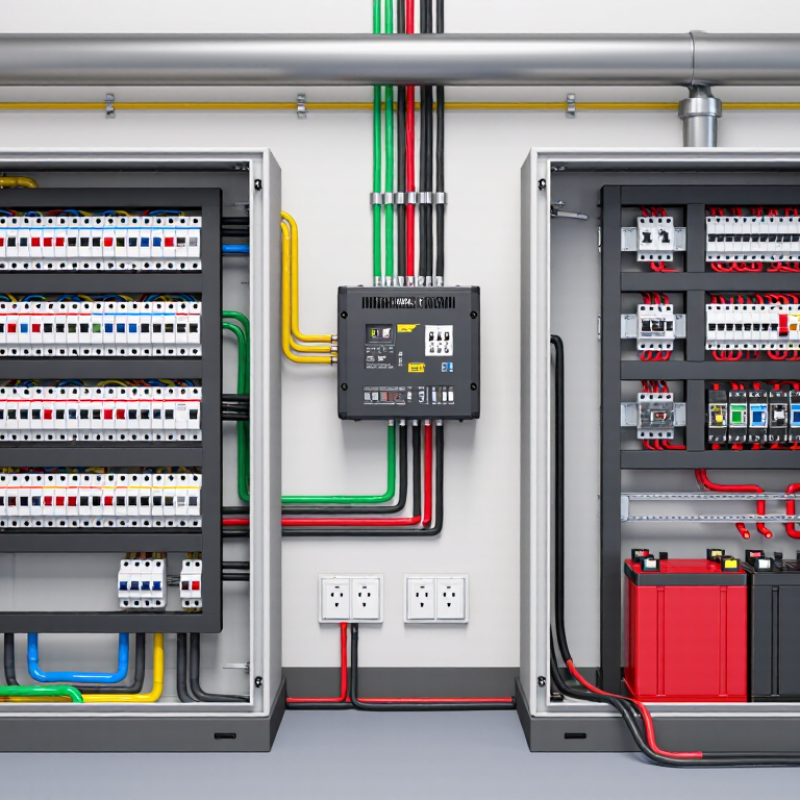
AC and DC distribution panels differ in how they manage current and protect circuits. AC repeatedly changes direction, while DC flows in one direction. That difference matters. AC panels commonly serve building circuits and use components designed for alternating current. DC panels often distribute power from batteries, solar arrays, or other direct-current sources.
Protection devices are not automatically interchangeable. Interrupting a DC fault can be challenging because the current does not pass through zero as it does in AC systems. A panel must use breakers and switches rated for its current type, voltage, and expected fault level. In inspections, polarity markings are an easy detail to overlook. Reversed connections can cause equipment problems. Small labels help.
Tips: Check the source, system voltage, and device ratings before selecting a panel. Confirm that every breaker, fuse, and disconnect is suitable for AC or DC service. Leave room for future circuits, but avoid oversizing without a load assessment. If the drawings and panel labels disagree, pause and verify the design with a qualified electrical professional. I would not rely on appearance alone; the two panel types can look nearly identical.
How to Choose Between AC and DC Distribution Panels?
Where AC and DC Panels Are Commonly Used
AC distribution panels are common in homes, offices, factories, and commercial buildings. They divide utility-supplied power among lighting, receptacles, HVAC equipment, and motors. A workshop panel might feed several 230-volt circuits, each protected for its cable and load. AC suits these settings because the grid and most building equipment use alternating current. Panel selection still depends on voltage, fault-current rating, environment, and the equipment’s specifications.
DC panels are commonly used with solar photovoltaic arrays, battery storage, telecom systems, and DC-powered equipment. They manage direct-current circuits between sources, storage, and loads. DC faults need particular attention: current does not naturally pass through zero each cycle, so interruption and arc control require correctly rated equipment. Lawrence Berkeley National Laboratory’s 2024 United States Data Center Energy Usage Report estimates data centers used 176 TWh in 2023, about 4.4% of U.S. electricity. That scale helps explain interest in efficient power paths, including DC systems inside some facilities. It does not mean every data center should use a DC panel.
Tips: Match the panel to the source and load, then verify voltage, current, and interrupting ratings with a qualified electrical professional. Check the actual one-line diagram. It may not reflect later equipment changes, so field verification matters.
Representative voltage examples show where AC and DC distribution panels are commonly used.
AC panels are common in homes, commercial buildings, and industrial facilities. DC panels are commonly used for control circuits, telecom power, and photovoltaic systems. AC systems often provide more than one voltage, as shown by the paired values in the labels; actual DC system voltage varies by application and design.
Assess the loads before choosing a panel. List each device, its voltage, current, and operating schedule. Include motors, lighting, battery storage, control circuits, and sensitive electronics. Start with the loads. Record peak demand, not just average use; a pump starting at 6 a.m. may draw much more current briefly. Check cable distances and room for future equipment. A tidy spreadsheet can still miss awkward realities, like a cramped cabinet or a planned machine upgrade.
AC distribution suits many building loads and is often practical where utility power and standard AC equipment dominate. DC distribution may fit systems with batteries, solar generation, or DC-powered electronics. Compare conversion losses, wiring distances, protection devices, and maintenance skills. DC faults need particular care because interrupting direct current can be challenging. Use components rated for the system’s voltage and fault conditions. An experienced electrical professional can verify calculations and local installation requirements.
Tips: Sketch the power path from source to load. Note where conversion happens, and estimate the cost of each conversion stage. Check available panel space and label every circuit clearly. Leave room for change; requirements rarely stay perfectly still.
Choosing a distribution panel starts with the loads it must serve, not with a preference for AC or DC. AC panels suit buildings with grid-fed equipment, such as lighting, motors, and standard receptacles. DC panels are often a better fit for battery systems, solar arrays, telecom equipment, and other DC-powered loads. That detail matters.
Look at the full power path. If a battery supplies DC loads directly, a DC panel may avoid an unnecessary conversion step. If most equipment uses AC, an AC panel can keep distribution straightforward. Mixed systems may need both panel types, with properly selected conversion equipment between them. Check voltage, current, fault protection, and the ratings of every connected device; panel suitability depends on these details.
Then match the panel to the site. A small backup system has different demands from a workshop with motor loads or a remote site with limited maintenance access. Allow room for future circuits, and consider enclosure conditions such as dust, moisture, and temperature. In field planning, overlooked load changes can make an initially adequate panel feel cramped. I would revisit the load list before ordering. Have a qualified electrical professional confirm the design, protective devices, and installation requirements for the specific system.
Before choosing AC or DC, verify the system’s actual voltage, maximum current, and available fault current. Match the panel and every protective device to these values. DC circuits need switches and breakers specifically rated for DC; AC ratings cannot be assumed to apply. Check conductor size, enclosure rating, ambient temperature, and room for future circuits. Small details matter.
The system layout determines where each panel belongs. In a solar installation, for example, DC circuits may run from the panels to an inverter, while AC distribution serves loads downstream. The IEA’s Renewables 2023 report recorded nearly 510 GW of renewable capacity additions in 2023, with solar PV accounting for about three-quarters. That growth makes careful circuit identification and isolation especially important. Check the label.
Review drawings and equipment schedules, then confirm grounding, overcurrent protection, interrupting capacity, and coordination with upstream devices. Verify that the selected panel suits the installation environment, including moisture, dust, and heat. Have a qualified electrical professional check the design against applicable codes and manufacturer instructions. A tempting shortcut is to compare only panel price or amperage. That misses compatibility—and I would recheck the fault-current calculation before ordering.
| How to Choose Between AC and DC Distribution Panels? — What to Verify Before Selecting a Distribution Panel | |||
|---|---|---|---|
| Selection Factor | AC Distribution Panel | DC Distribution Panel | What to Verify Before Selecting |
| Power system | Distributes alternating current, in which voltage and current periodically reverse direction. | Distributes direct current, with current flowing in one direction under normal operation. | Confirm the system type and ensure every panel, protective device, and connected load is rated for it. |
| Common voltage examples | Examples include 120/208 V and 277/480 V systems in North America, and 230/400 V systems in many other regions. | Examples include nominal −48 V telecom systems and photovoltaic circuits whose operating voltage depends on the array and equipment design. | Check the nominal and maximum operating voltage, phase arrangement where applicable, and the equipment nameplate ratings. Examples are not universal standards for every installation. |
| Typical applications | Building lighting, receptacles, HVAC equipment, and many commercial or industrial loads supplied by an AC source. | Battery systems, telecommunications equipment, solar photovoltaic circuits, and other loads designed for DC supply. | Match the panel to the actual source and load. Do not assume an AC panel is suitable for DC, or vice versa. |
| Protective devices | Uses AC-rated circuit breakers, fuses, and other protective devices selected for the system voltage and available fault current. | Requires protection devices specifically rated for DC voltage, current, and circuit conditions. DC arcs do not have the natural current zero crossings found in AC systems. | Verify device ratings, polarity requirements, interrupting capacity, and compatibility with the panel. Use protection approved for the intended current type. |
| Fault-current rating | The panel and protective devices must safely withstand and interrupt the prospective AC fault current at the installation point. | The panel and protective devices must safely withstand and interrupt the prospective DC fault current; battery and PV sources can have distinct fault characteristics. | Obtain the calculated or specified available fault current and confirm that the assembly and devices have adequate ratings for the installation. |
| Polarity and connections | Connections depend on the supply configuration, such as single-phase or three-phase, and the panel design. | Positive and negative conductors, and any required polarity-sensitive devices, must be connected as specified by the equipment design. | Review wiring diagrams, terminal markings, conductor identification, and source/load polarity before installation. |
| Grounding and bonding | Grounding and bonding arrangements depend on the supply configuration and applicable electrical rules. | DC systems may be grounded or ungrounded, depending on the system design and applicable requirements. | Confirm the system grounding method, bonding points, protective-earth connections, and required ground-fault monitoring or protection. |
| Metering and monitoring | Metering may include voltage, current, power, and energy measurements appropriate to the AC system. | Metering may include DC voltage, current, power, and energy measurements; instrument polarity and DC ratings matter. | Check that meters, sensors, communication interfaces, and monitoring equipment are designed for the current type and system range. |
| Expansion and layout | Panel capacity depends on the number and type of circuits, bus rating, enclosure, and available space. | Panel capacity also depends on DC circuit ratings, polarity arrangements, protective-device compatibility, and available space. | Allow for expected circuit growth and verify bus ratings, spare ways, enclosure conditions, cable entry, and maintenance access. |
| Compliance and environment | Requirements depend on location, installation type, and the applicable electrical codes and product standards. | Requirements likewise depend on location and application; PV, battery, and telecom installations may have additional system-specific provisions. | Confirm applicable local codes, certification requirements, enclosure protection, temperature limits, and installation instructions with a qualified electrical professional. |
AC current repeatedly changes direction; DC current flows one way. Their protective devices need matching ratings. Easy to miss.
An AC panel commonly serves grid-fed lighting, motors, and standard receptacles. Check the equipment’s actual supply before choosing.
DC panels often distribute power from batteries, solar arrays, or telecom equipment. They may avoid an extra conversion step for direct-current loads.
No. Each device must be rated for the current type, voltage, and expected fault level. DC faults can be harder to interrupt.
Confirm system voltage, maximum current, available fault current, conductor size, and enclosure conditions. Dust, moisture, and heat matter.
It may use both panel types, with suitable conversion equipment between them. Trace the full path from source to load.
Clear polarity markings help prevent reversed connections and equipment problems. Check labels against drawings. Small labels matter.
Yes, but size the panel using an assessed load, not guesswork. Revisit the load list; I might overlook a future change.
Choosing between AC and DC distribution panels starts with understanding how each handles electrical power. AC panels distribute alternating current, which is common in buildings and utility-connected systems, while DC panels manage direct current, often used with batteries, solar installations, and other DC-powered equipment. Knowing what is the difference between ac and dc distribution panels helps clarify which option fits the system’s power source, connected loads, and operating conditions.
Before selecting a panel, assess voltage, current, load characteristics, expansion plans, installation environment, and protection requirements. Match the panel type to the application rather than choosing by familiarity alone, and verify that its ratings, circuit protection, wiring, and compatibility meet the system’s needs. Careful evaluation can support safe, reliable distribution and make future maintenance or upgrades easier.

Sowest Electric